What is the 50 State Challenge? • Want to join the Challenge? Email me here.


Thursday, June 29, 2017

How to Teach or Learn Any Physical Skill: Martial Arts and Drumming Part I

This is Part 1 of 3 in the Martial Arts and Drumming series.

This project started innocently enough.  I thought that in lieu of my 50 States Challenge, I'd try something I've never done before and see what I could learn from it as a martial artist.  My vision was distant and vague, but I thought I'd write a blog post for my students to illustrate the value in being open-minded to new experiences and willing to learn in any situation. 

Four months of drumming lessons, interviews and general pandemonium later, this sure has snowballed.  I'm honored that there has been so much interest in this project.  I have been very far outside of my comfort zone on this project, and it has been one crazy and awesome ride.  I hope you find something of value here, or at least that you enjoy it even half as much as I did.


Being a Terrible Drummer (or a terrible martial artist for that matter)

There is very little about drumming that I can speak to with any degree of authority, but one thing I can say is that being a terrible drummer is awesome.  It is so awesome that I almost feel sorry for people who are actually good at it.

As a beginner, I'm supposed to be a terrible drummer, but more importantly, I'm allowed to be a terrible drummer.  I can sit down to practice some simple rhythm and make a mistake in every single measure, and the worst thing that is going to happen is a big dopey grin.  The stick in my left hand can bounce so chaotically that you might think I have some serious medical condition, but that just makes two consecutive good strokes feel like a real victory.  Move over, Hercules—this legend just played a whole fill!  (Cue the cheers and ticker tape.)

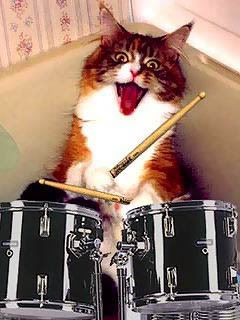
I will never look this cool playing the drums.  Good thing
blogging is the ultimate form of artistic expression.  It is, right?

I don’t have that in martial arts anymore, and haven’t for a long time.  In martial arts, I have expectations on me.  If I do something badly, it reflects poorly on me, my school, and my instructors.  I have students who are counting on me to train them well, provide good information and set a great example.  Don't get me wrong—I love it.  It's still fun, but it's a very different kind of fun. 

As an instructor, I greatly enjoy seeing a struggling white belt who is having fun.  Here's the thing about people who do something badly and are still having fun:  if they're having fun, they're going to practice.  If they practice, they'll get better.  In my experience, the people who are having fun in martial arts go the farthest, regardless of whatever natural talent they may or may not have.  They're the ones who stick with it and persevere when things get tough.

So what that means for me as a terrible drummer is that it's just a matter of time before I'm merely a bad drummer.  If being a bad drummer is as much fun as being a terrible drummer, I'll someday be a mediocre drummer.  And if that's fun, well, by then I'll probably be 150 years old and my interest will probably have waned, but you get the idea.  When I started martial arts, I never thought I'd do any of the crazy things I did.  I was one of those picked-last-in-gym-class kids.  When I was a white belt, I had this lofty goal of being a green belt someday.  People who know me as a 4th degree black belt tend to find that pretty funny, but there's an important lesson there.  Please, if you take nothing else from this blog, just go do something fun.  Don't worry about whether or not you're good at it.

That said, let me set this straight now.  There will never be video evidence of me playing drums.  That would be ceaselessly vain.  (Would you keep reading if you knew that I was lying?)

I have no idea what I'm doing! Photo credit.

One caveat that instructors need to watch out for is that teaching your students to love an activity is a learning goal, not a retention goal.  Especially when it comes to teaching kids, sometimes the students' enjoyment of class is cynically filed under business goals, because if they're having fun their parents will keep paying.  There's some truth to that, but by thinking of fun as a retention mechanism and not a learning mechanism, you're doing your students a disservice.  Likewise, teaching your students to enjoy martial arts is not the same as teaching them to enjoy a class.  You can take a group of kids, play games with them for 90% of a class, and send them home happy.  They might have had fun, but they have not learned to enjoy martial arts.  As an instructor, your challenge is to make the 100th roundhouse kick of the day as fun and engaging as the 10th.  Then your students have learned their roundhouse kick lesson and also have developed a positive attitude toward roundhouse kicks.


Poison for Beginners

Being a beginner is a delicate time when you're deciding whether this new activity is for you.  The best thing a beginner can do is establish a positive relationship with whatever they're trying to learn, whether it's drumming or martial arts or anything else.  If you can love it, you're halfway there at least.  If that means skipping a day when you're not in the mood, that is completely fine for a beginner!  Having the discipline to practice when you're not in the mood comes later, after you have already decided that what you're doing is important enough to endure the grind.

I absolutely hate it when people advise beginners to practice every day.  No one gets good at anything because they decide they will practice every day.  They get good either because they are forced to practice, or because they love doing it.  If they are forced, they will resent the activity and quit as soon as they can.  It's the people who love it who go on to become great.  Look at any great achiever in any field.  They didn't get there without hard work, but the passion always comes first.  It's that passion that allowed them to do all that work.  You're no different, and your students are no different.

Let's not poison this eager learner.

Poison for beginners is anything that can damage the student's relationship with the activity.  It can come in a lot of forms, but the most common forms are frustration and boredom.  If you're the instructor, you need to read your beginners very well and steer them clear.  This is easier said than done of course, but a good teacher can do it by encouraging at the right times, pacing the lesson well, or scaling the difficulty of the practice.

I was very lucky to have a drum instructor who excelled at this, and I'll share a story about that later, but first I need to introduce one more concept...


The Uncomfortable Place of Growth

The "uncomfortable place" is practice that is at the optimal challenge level.  It is right at the very limit of your skill where you are working very hard.  Being there gets you the most efficient growth but is exhausting.  If it's too hard, you'll get very little out of it.  If it's too easy, you'll get even less.  It's that sweet spot in between where the growth happens, but it is by nature uncomfortable.  That's why it's called "being out of your comfort zone."

How much time you should spend in that uncomfortable place depends on a lot of things.  Beginners should keep their time in that zone short.  Too much time in the uncomfortable place can make them learn to dislike the activity because practicing that way is decidedly not fun.  They might approach that place with enthusiasm, but staying there too long without breaks will wear anyone down.  Age matters, but not as much as temperament.  Reading the student(s) is paramount.

Adults often (but not always) have more patience for
the uncomfortable place than young kids do.

One thing to keep in mind is that there are two ways out of the uncomfortable place.  A good teacher knows how and when to manage both of them.  The first is when the student gets better.  Suppose you're working on some detail of your technique--let's say keeping the spine straight and relaxed during a front kick.  Let's say you get it right 10% of the time, so you practice for half an hour until you get it right 90% of the time.  By the end of that half hour, you are no longer in the uncomfortable place.  You are enjoying a high success rate, and you are still improving, but not as much or as quickly as you were before.  If you want to stay in the uncomfortable place, you need to increase the difficulty, for example by increasing the speed.

The second way out of the uncomfortable place is when you dial back the difficulty of the practice.  Let's go back to the front kick spine example.  Let's say the student is getting it right 10% of the time, and after half an hour of practice he's getting it right 15% of the time.  This student is absolutely still in the uncomfortable place.  However, this student is also getting poison.  Veteran martial artists (or substitute any skill you like) have already made a commitment to their art, and can endure a little poison.  But the beginner who is still deciding whether they like this crazy martial arts thing is not likely to respond well to the frustration.  Even if they're not frustrated, they are most likely not having fun.

I've seen instructors who are very good at reading their students, and others who are completely oblivious.  I've seen my drum instructor spin on a dime when he suspected I was getting frustrated, changing gears so fast it was almost comical.  It's exactly what I would have done--it's better to overreact than underreact with beginners.  On the other extreme, I once saw a martial arts instructor bombard a beginner with a dozen details on one movement for a full hour with no breaks from being in the uncomfortable place.  This usually does not end well.

It doesn't always end badly, though.  It all comes down to reading the student, and as promised I have a story about my drum instructor doing this to me successfully.  One day I wondered if my instructor (Kai Andersen, who I will introduce properly in Part II of this series) might be a bit perplexed because most of the music I listen to doesn't lend itself to beginner drum lessons.  So I suggested a song that was slow and repetitive enough that I might be able to play it.  At my next lesson, he listened to the song for the first time.  He penciled some changes to a couple exercises in my lesson book so that I essentially had sheet music for the song.  But since what he had written was still too advanced for me, he scaled it back and built a challenge-appropriate lesson on the fly using that song as a guide, and I spent the entire time in the uncomfortable place, making good progress.  I was mentally exhausted by the end of it, and also really impressed with Kai.


Can You Even Teach Art?

A while back, Barry Eisler did an interview with Kris Wilder (the entire interview is here, and well worth your time) and had this to say on the topic of teaching art:

"There's this stupid meme that goes around in the writing world which is... 'You can't teach writing and you can't teach art.'  This is a dumb thing to say, and here's why.  It's true that you can't teach art directly, but art is built on craft. ... You can't express yourself as an artist if you don't have a deep understanding of craft, and craft can be taught."

This reminded me greatly of something Grandmaster Park used to talk about.  He didn't call it craft; he called it steps.  He would say that learning steps was easy, but making art was very hard.  One day after watching my Jang Kwon he told me that my steps were as technically correct as they could be, and now I have to make art.  He said that only comes after years and years of practice.  Back then I didn't really understand what he was saying, and certainly it's possible that I still don't.  In the wake of this project, I think I understand him better now.  At the time, I was saddened thinking that he didn't want to teach me anymore.  In retrospect, that was ridiculous and I feel awfully foolish even typing that out.  Now I think that he was telling me that he had taught me the craft to the limit of what can be taught, and any improvement from there would have to be my own expression.


The difference between art and craft: Picasso's
TĂȘte was made by cutting and pasting paper, not
because that was the limit of his craft, but
because that was his artistic choice.

Eisler goes on to say, "One of the ways that craft should be and can be taught and learned is pay attention to the art.  Experience it, enjoy it...  If you read a passage in a book and it blows you away for some reason... If you're just a reader, ... why would you want to pause to say 'why did this blow me away so much?'  But if you are a writer and you are trying to become a better writer, you might pause and say, '...this passage had a magical effect on me, but it's not real magic.'  There must be something that the writer is doing that created that effect, and there is.  There always is. ... You can definitely extract certain techniques by watching and thinking about what the other person is doing."  He goes into specific examples like appealing to multiple senses and juxtaposing nearby details against a wider view of the scene.  

He even ties it back specifically to martial arts, saying, "When you start asking yourself those questions, then you can start to see the craft behind the art, and the more conscious you become of craft, the more you can duplicate it yourself.  And it's true for anything.  It's true in martial arts, self defense… The first time someone does something to you, it feels like magic.  Like, 'Oh my God, how did you do that?  I'm on my butt!'"  Of course, it's not magic.  It's applied movement and biomechanics--things that can be learned.

I'm going to take it a step farther than he did, though. I'm going to claim that you can't teach art, and really you can't teach craft either. Even if you're the best martial arts instructor in the world, you can't really teach martial arts. All you can do is make it easy for someone to learn. Kris Wilder once told me that teaching is about helping people find something inside them that was already there, and he was so right. The student is the one who has to make the learning happen. The instructor can and should be a big part of that, but ultimately you can't make students learn, you can only let them learn.

That doesn't mean that if your students aren't learning it's not your fault.  It means that your job is a lot harder than it seems on the surface.

So how do you make something easy to learn? Of course you must have the skill you hope to impart, but mostly it comes down to creating the right experience for the students. A great instructor can optimize your training time, motivate you to push yourself, make it easy to grasp difficult concepts, keep you focused, balance the time you spend in the uncomfortable place, and make practice enjoyable enough to be continued. That is how craft is "taught," by effectively creating experiences that allow the students to learn.

Eisler's idea of analyzing art to learn craft has been at the front of the chaos in my mind over the course of this project. One thing that struck me is the thought that like writers, drummers and martial arts instructors are in the business of creating experiences.

Engaging Crowds, Classes and Individuals

First let's take a little break and watch Casey Grillo do a drum solo.  I interviewed him for this project and I'll introduce him properly in Part II, but for now just enjoy...


That was fun, but why? What exactly was he doing that got the audience to respond the way they did? These questions are perhaps too advanced for me. I'm at the level where any day that I don't hit myself with my sticks is a good day, so some things under the sun just aren't going to be understood. This video was taken at a Kamelot concert, in front of his own fans, and that probably meant the crowd was especially receptive to what he was doing. But I saw him subbing for another drummer in another band, and he got similar reactions out of Scott Rockenfield's fans.

Since I'm so far out of my depth on this one, I'm going to break this down in terms of what I already know about engaging people. I have taught martial art classes of a wide range of ages and experience levels, with students of varying degrees of physical wellness--sometimes all at once. I've also taught English as a second language to all ages and skill levels, and to several different languages of origin. That may seem like it requires a huge set of diverse skills (and in a way, it does) but ultimately it still comes down to reading the class and giving students the right experience so they can learn.

It's only a little different with a single student. Private lessons that are run like group classes tend to be awkward affairs. I like to allow for a more casual back-and-forth experience when I teach a single student, as that tends to be a great opportunity to create a very directed experience for exactly what that student needs. Certainly Kai teaches my drumming lessons that way as well.

When I create experiences, it's with fairly small groups. The biggest class I ever taught had about 45 people in it. That's small enough that I can speak loudly and clearly and be heard just fine. And that's good, because most of the tools in my bag rely on the spoken word. In the video, Casey is creating an experience for a much larger group using only percussive sounds and nonverbal cues. That's practically magic to me because the techniques are so different, but some of the broader ideas are the same.

Looking at these three scenarios, I notice four things in the video that are relevant to creating engaging experiences for crowds, classes and individuals. There may be others, but as I see it, an experience is most engaging when:

1. It is interactive. Getting people involved, whether they're clapping along with your drum solo, or seeing how hard they can kick a target, or bringing in their own songs to a drumming lesson, makes for a more engaging experience.

2. The pacing is good. One thing I notice about that drum solo is that he changes up what he's doing fairly often. It might be more impressive to pick the most challenging part and just do that continuously for four minutes, but that wouldn't be as engaging. Changing up the activity is extremely important in teaching as well. Not only does it keep people from getting bored, but it also makes it easier to learn because lessons sink in better if you break up your explanations with practice and vice versa.

3. It ends when it should. Grandmaster Park told me once that beginners' classes should be no more than 50 minutes. Any longer than that, and the training begins to drain on people and novices can leave with a sour taste in their mouths. But a 50-minute drum solo would probably be too long to be enjoyable. Likewise, a 4-minute martial arts class would be ridiculous.

4. It's about them. This might be my biggest pet peeve in martial arts. I've seen instructors who are incredible martial artists, but they fail as teachers because they don't make the classes about the students. They like being in charge, they like being the center of attention, or they like showing off--all of which are fine to enjoy, but if any one of those things is your priority, you will never be a good instructor. As an instructor, the only measure of your success is your students' success. Their experience. Not yours. I'll bet that a drummer who is focused on his own experience would also fall short of one who puts his audience first.

-

This series will be continued with 11 Ways Drumming Can Help Your Training: Martial Arts and Drumming Part II.

Saturday, December 31, 2016

One Year of Running a Martial Arts School

In a few hours Martial Journeys LLC will be a year old.  I have more than usual to think about this New Year's Eve while reflecting on the past year and anticipating the new one. Today I went through some of the things I've written about starting and running a school. They are stories of happiness, minutiae, exhaustion, pride and especially gratitude.  Here are some highlights that I hope are interesting to read.
Day 11:  Tomorrow Martial Journeys of Madison holds its first class and I'll be doing my very best to grow it into a prosperous traditional martial arts school run with integrity. I don't expect it to be easy, but I know it will be worth it.  It's the first follower who makes a leader and it's the first student who makes a teacher. E made me the head instructor of Martial Journeys of Madison.
Day 35:  Class today, a comparative analysis of different styles of sparring, went really well. The website is almost done, but I need a chunk of time to sit down and write some things for it. I have come up with a subject rotation including sparring/forms/technique and so forth, but I have one subject that needs a better name because "The Carlson Grab Bag of Doom" doesn't look good on a calendar. I finally took pictures of the new mats from our anonymous donor, and those will get posted tomorrow. I don't have storage for the mats, so they get piled up in the computer room of my apartment, which so far has been a pretty good workout for me. Getting the word out about the class continues to be tough, as does keeping up with everything on top of a full time job. 
Thanks to our anonymous donor!
Day 60:  I'm tired. Really, really tired. Stuff isn't getting done fast enough. On the plus side, I'm very proud of the classes I've been teaching. I've got some great mentors. And I've got some of the best students an instructor could ask for. The folks at the community center have been awesome. I've had surprise visits (and planned visits) from people I haven't seen in ages who just stopped by class to show their support, and that is greatly appreciated. Trekking on.
Day 79:  I spent some time on the technical side of the website, enough for it to occur to me that I don't miss being a professional programmer. I also retrieved my USB drive, which thankfully did not make it all the way to the same stash where the kitten has taken all the dry erase markers, as I still have not been able to find those. I'm still working on outreach, trying to get the word out to prospective students. It is very strange to me that my adult program is growing easier and faster than my kids program. I have a ton more experience teaching kids than teaching adults, and I find myself now teaching at a consistently more advanced level than I ever have before, especially for the black belts. They're at times challenging classes to teach because of the caliber of the students, but I'm proud of the results, and moreover incredibly honored that people like these have chosen to forward their martial education with me. When I think about that, it leaves me inspired to be a better instructor, and to build a school worthy of them and all they can be.
Although the adults seem to be doing okay so far.
Day 118:  I took the day off today. Today is the first day when I didn't do either job. It's scary, with the slow summer months coming up, and it feels like I'm being incredibly lazy to just take a whole day to just take care of myself and relax. But if I'm only doing that once every 118 days, it will probably be okay.
Day 131: Equipment order came in just in time, as I have a new student starting today. Despite the printer's determination to die its slow, sputtering death, I did get all my forms printed and should be good to go for the week at least. There is never enough coffee. The bags I haul the mats in are disintegrating, which is much more fun for the kitten than it is for me. My reading list is getting longer instead of shorter, but I did finally order a copy of A Killing Art, which has been recommended to me repeatedly. I read a little bit of Word of Mouth Marketing and got an idea for my web page, and I read a little bit of a sparring book and got an idea for a drill to try sometime. Tonight is forms, though. I didn't get any training in today, which is par for the course on a Tuesday, but maybe it's just as well since I'm still recovering from how hard I kicked my own butt on Sunday. I still just plain need more hours in a day, but for all my complaining, it has been a long time since I have been this happy.
I wasn't very happy with the original mat storage situation.
Day 142:  What is the opposite of a well-oiled machine? A disaster of gears and springs? That's my life right now, except instead of gears and springs, it's caffeine and productivity. This week has been particularly rough, with 2 new students, three walk-ins, my first time running a public demonstration, a last minute performer change, and also a couple days of being pretty sure that one of my cats was going to die. But for all my complaining, things are really going great. The demo went well and doubled nicely as a lesson for some of my more advanced students about the confluence of nervousness and readiness, which I really should write up into a blog post at some point. 
Part of our first public demonstration.
Day 150:  I printed a bunch of stuff, cut a bunch of papers, ordered some more clipboards, and fretted over the bank account. Who ever said running a business wasn't glamorous? Computer work is especially cumbersome today due to a dying mouse. I'm still finding it difficult to achieve any kind of work/life balance, but at least I have lots of practice with that from my video game industry days. 
Day 168:  Thursday is my weekend, which is to say that once a week I have 27 consecutive hours that I don't need to be at either job, and most of them fall on Thursday. I do often have to spend much of that time on the business, but this time I'm spending most of it on personal development. Last night was for study, (keeping up on taekwondo news, business podcasts, a couple short taekwondo documentaries, reading articles and opinion pieces about martial arts, and the like) because I was just too physically drained from the week to do any physical training. Today I'm meeting a training partner and hitting the gym, though--something that doesn't happen nearly often enough.
I find myself saying "Someday I'm going to have..." a lot. "Someday I'm going to have my own space with mirrors and it will be easier for you to learn this," or "Someday I'll be able to quit the day job and I can train every morning," or "Someday I'll be able to offer more classes per week," or "Someday I'll have a ton of assistant instructors and everyone can get more one-on-one attention in class." All that is true, but I also worry about things like "Someday I'm going to have to raise my prices," or "Someday this school will be so different that the people who love it now won't recognize it, and I wonder if they'll still love it." I've always hated losing people, even before it was linked to the health of my business.
I'm doing a better job of taking things one day at a time. Now that the business can cover its own expenses, I no longer feel like I'm in a race against the clock to build the school up before the money runs out. I have the luxury of spending an evening on my own development instead of on the school, like I did last night. I can even take an evening and play video games without too much guilt. It will be a long time before I can take home a paycheck, though. Any money coming in has to go right back into the business. I'm okay with that. I'm still working too many hours, but it's no longer unsustainable.
Day 183:  The vehicle and driver I've been relying on to haul the mats from my apartment to the community center are no longer available. So I need a van pretty much right now. The mats don't fit in my car, so it has to be a larger vehicle. But since I wasn't anticipating this expense just yet, I don't exactly have money set aside for it. 
Day 194:  Today was an impressive barrage of awful. I called in sick from the day job to try to take care of some business things that needed the extra attention. Last week my credit union outright refused to work with a business that has been around for only 6 1/2 months, but today BMO Harris came to the rescue and offered to do an auto loan with a scant 40% interest rate. I'm not so sure they're going to be my bank anymore.
I took a pretty hard gut punch in my kids class today when I announced some upcoming changes to the program. Most of it was good news, but the bad news was that I have to raise my rates to go with it. It's all going to happen later--I just figured it was fair to give everyone as much advance warning as possible. And I don't expect anyone to be happy about paying an extra $20/month, but I was surprised at the push-back, and I took it harder than I expected. I've taught martial arts for over a decade, and in that time, no one has ever been my students like these students are. I have done my very best for them, and the thought that I might lose them over a small rate increase, especially when I am still so far below the industry average, was pretty rough.
I also had someone suggest they might not sign up at the end of their intro--which just hasn't happened to me before. I have been so proud that every single person who has given this school a try has decided to stay, and I was saddened that someone is lukewarm.
It wasn't all bad, though. I ran into a student from years ago, and caught up with him a bit. I also met a business mentor for lunch and had some really good Indian food, before taking a break to get roflstomped by zerg. I miss being able to train away my troubles like I did when I was taking 17 classes a week, but milkshake and StarCraft breaks are almost as effective even if not nearly so good for my figure.
Day 196:  One kid learned her first punch and had a great time doing it. Another kid's side kick improved by leaps and bounds. Another did the same for front kick. One kid made huge strides in focus. One adult got better at spin crescent kick today. Another complained of tight hips on side kick and learned a drill to help the problem. One adult learned a new kick and is already doing it like he's had a month of practice. Another adult expressed some concern about his back leg roundhouse kick, and ended the class with a thunderous clap against a body shield. There is something immensely satisfying about a small class, where you can be certain that every single student got exactly what they need. And I did too. After how rough things have been lately, nothing could have done me better than a great class highlighting all the reasons I'm doing this.
Day 210:  A few years ago, I had someone very bluntly suggest that I had no business sense and could not be taught. Well two weeks ago I had a family say they wanted to quit, but today they signed up and brought three referrals. I clearly should give up now. To paraphrase A and D, haters can go step on a Lego. I also taught what was probably Wisconsin's first ever taekyun class, which sounds pretty cool on paper at least.
Wisconsin's first ever taekyun class?  We think so, but don't know how to fact-check it.
Day 217:  I had to have a talk with a couple black belts today. Yes, I'm the owner and head instructor and all that, but they can't underestimate their role here. They are pillars of this school, and they always will be. They're here from this school's infancy, every day helping to build it and let it grow. Even if they quit today and never came back, they would still have left their mark here. In fact, anyone who's here from the beginning like this is helping to define what the school's community will be for years to come. I can't let them ever think they don't matter here.
Day 224:  I love my tiny school, and I'm proud of my students and how far they've come in the short time that we've been around. Earlier today I was thinking about how happy I am, and how seeing misfortune in my friends' Facebook feeds is just so unfair. I've never before felt like I had an obscene surplus of happiness that I wish I could siphon off to friends who are not so lucky. Tomorrow we're running our first belt test, and we are so ready. The students have worked hard to hone their skills and I have spent an absurd number of hours on logistics, and I'm confident that it will all come together.
Martial Journeys of Madison's first belt test.
Day 238:  When a school is this new, there are going to be many firsts. Most of them are happy things, like the first class, first signup, first belt testing, and so on. But today's first was not so great. Today Martial Journeys of Madison lost a student for the first time. He's been my student longer than this school has even been around, and now he's grown up and going to college. It takes a pretty lousy instructor to not call that a win, but I'm sure gonna miss him.
Day 263:  I have finally achieved one of my longest-standing goals, which was to cut back my day job hours to make room for more dojang hours. I now go to Captel only five days a week, and we're now holding classes three days a week. Our first Saturday class didn't go terribly smoothly. There were no major problems, but enough minor ones to be an annoyance. The next one should go better. Also, there was a lot of interest from people who didn't know we were there until we showed up during their Saturday events, so I hope to be signing up a few more intros as a result. Today we had our second belt test, which was a bit underwhelming as only one student was ready to test. He did great, though, and I'm very happy to finally see a yellow belt on him. It's getting near October, and I'm cooking up schemes for a Halloween event. Ahem--because I am a shrewd businessperson, and not because I'm a giant kid who loves Halloween. I will not publicly admit to thinking an adult zombie-themed tai chi class would be awesome. (Tai chi is generally performed slow, making it ideal for fending off zombie attacks. Har har.) The school is growing slowly but steadily, and it is still a balancing act between coffee-fueled productivity and not dying of caffeine overdose. I feel awfully naive for ever having thought it would be about teaching good classes and running an ethical business. Those things now seem very secondary to seeing how much caffeine I can get into my system.
The actual owner and operator of Martial Journeys of Madison.
Day 266:  I pulled the veil back a little bit for my students today into the behind-the-scenes. I never said anything before because I didn't think they'd be interested. But today one of the kids noted with surprise and delight that I had more kicking targets than before. I told him that's because the school could afford them. I explained that when his parents (and everyone else) paid for classes, all of that money goes back into the school, to make it a better school. I listed a few things I've spent the school's money on, and another kid added, "And a little bit for you!" He was shocked when I told him no. There are so many things I'd rather buy for the school than my own paycheck. I want more classes per week, our own facility, more mats, more advertising, storage, visits and seminars from my instructors in Korea and elsewhere, and a hundred other things.
As the school grows, someday the limiting factor will be my time and energy, and that's when I'll give myself a paycheck. Even then, it will be just enough to quit the day job so I can put my time into the school. I don't need a giant pile of money. And until the school is everything I want it to be, my paycheck is the least of my concerns.
Coincidentally, it came up in conversation after the adult class that only a small percentage of my business time is spent teaching. I only spend 4 1/2 hours a week teaching right now, and the rest is not glamorous. Setting up before class, packing up after class, filing, organizing, managing the money, making sure things are ordered when they need to be, talking to students, talking to parents, coordinating with the community center, and so forth.
I guess my students thought this was a much cushier gig than it actually is! Not that I'm complaining. Even on the worst days of exhaustion and frustration over any aspect of running this school, I am still very, very glad I did this.
Day 297:  I've come to a sort of holding pattern, where I am semi-comfortable in that the business can fund itself for the foreseeable future, but I'm not unsustainably burning the candle at both ends. The downside is that the school is not growing. I have been dreading putting myself back into that insane crunch mode, but it has to happen if the school is going to grow again, and if it's ever going to become what I want it to be. So I jumped back in a few weeks ago. I'm paying for it, as expected, but it is also paying off, as expected.
I've been saving up vacation time for a stop on my 50 States Challenge, but getting away seems impossible. My life sure would be easier if I had an assistant instructor, but it will be a long time before I can afford to pay one.
There are some fun things happening with the school, though. I'm adding a tai chi class in November, and an all-ages class on Saturdays so parents can train with their kids if they want to, and we're attending our first tournament next month. We're also getting a mention in the upcoming issue of Taekwondo Life Magazine.
But mostly the work has been far less than glamorous. I spent some of the school's money on a windshield scraper for the school's van, for example. Winter is coming, and the Winter Is Coming jokes are coming.
Day 318:  Today we went to our first tournament. It ended up being just myself and one student. I haven't been to a tournament in years, and I had forgotten how exhausting they are. This one wiped me out, and I didn't even compete. I saw a lot more familiar faces than I expected, which was cool. I am so happy with my single student's performance. He took first in forms. He lost his first sparring match by a single point, but soundly won after that for 3rd place. Running a tiny school has its challenges, and one of them is that the pool of sparring partners is not deep, so this was a very valuable experience for him and also for me to see how his skills stack up against a different kind of opponent, and how I need to adjust his training accordingly. I'm not sure when the next tournament will be, but I hope to take a bigger group. I also got just a little bit of a bug to compete again myself, but that is not realistic right now. 
First competitor, first tournament, first place.  Go B!
Day 357:  Today was the last class of the year. The kids class was small but went very well, with everyone making great progress on their forms. The adult class also went really well, though attendance was sparse there, too.
Even though I absolutely love my school and my students, I have to say I am looking forward to only having one job for a few days. I've only had two days off all year when I didn't do any work for either job, and that is no way to live in the long term, but it's going to continue for a little while at least. I'm excited for what the new year will bring for the school, though. It will all be worth it!
I'm so proud of my students. In the past year, they have each started their martial journeys and every single one of them has come such a long way. It has been incredible to see, and even better to be a part of. I am so happy.
Day 365:  Today I'm writing a blog post and doing a lot of reflecting. I have omitted names from this post, which has had the unfortunate side effect of removing a lot of the stories of how much gratitude I feel toward so many people. I have done a huge amount of work for this school, but it's the people around me who have made it possible for me to do that work. Students who feel that what I teach has value and is worth showing up and paying for, students who volunteer their time to make the school a little better, students who have worked hard to gain skill and prove that this school is a good one, people in my personal life who have supported me, friends who have helped me smile on the most exhausting days, instructors who taught me everything I know, readers who support this blog and the other one, mentors who have helped me learn and improve at every aspect of this. You guys are awesome.
Martial Journeys of Madison is one year old!

Saturday, April 2, 2016

Happy Times with Grandmaster Park Chull Hee

Many of you in my martial arts family already know that Grandmaster Park has passed away.  Today I am skipping work to write this post about happier times, because it's all I can do in the face of profound loss.  There's no way I can go to the funeral in Korea.  I want to do the normal things that people do when they mourn, but that involves friends, instructors, and training partners on the other side of a language barrier, and the world itself.

A wallet certificate for a martial arts master in taekwondo's formative years,
before they even nailed down exactly what to call the art.

While the world is a little bit less today for not having him in it, this is a post about happier times.

In fact, I'll start off with a Fish Story, which I wrote before I started this blog, at a time when a Guardians of the Galaxy reference was somewhat timely.

Fish Story

I have a fish story for you.

I wanted to take Grandmaster Park out to a nice restaurant before I leave Korea.  Being unfamiliar with restaurants in the area, I asked the taekyun staff for a recommendation. They suggested an oddly-named restaurant that translated to, "My mother cooked me fish."

So when I offered to take Grandmaster Park there, he absolutely could not understand why I kept telling him that my mother cooked me fish.  He was too polite to say, "Listen you crazy foreigner, I know for a fact that your mother didn't cook you fish, because your mother isn't even on this continent, and even if she did cook you fish, why do you keep telling me that?"  But eventually I got him to the restaurant and pointed at the sign, and perhaps he no longer worried that he needed to report me for some mental health screening.

When we got there, I saw that the pictures were not what I expected.  The taekyun staff told me it was "fried fish," so I imagined breaded and fried fish pieces, like you would get at a fish fry in America.  But no.  They served up whole fish.  I have a personal rule to not eat anything that looks like it did when it was alive.  Why?  Because I'm a wuss.  But Grandmaster Park seemed happy to be there, so I decided to suck it up and face my impending doom.

I get squeamish when I can't tell if it's a meal or a pet.

I was thankful when Grandmaster Park selected a dish that was served without a head or a tail.  I wouldn't have to worry that my meal would start screaming as soon as I poked at it with chop sticks.  And even more importantly, I wouldn't have to go all Yondu on Grandmaster Park's fish and save it from being eaten.  After a sigh of relief, I ordered two of them.

When the meal arrived, I had no idea how to eat it.  I'm pretty good with chop sticks at this point, but I couldn't imagine how to cut a fish with them.  So I focused on my soup until I could see Grandmaster Park do it.  He basically scooped the meat out like he was using a spoon.  I watched and copied, and managed to eat.  It was pretty good.

Using magical powers that I can only assume come somewhere around 9th degree, Grandmaster Park was able to turn his fish into two neat rows of bones that looked like they had been cleaned in a chemistry lab.  Mine looked like somebody had scraped some of the meat out, gotten frustrated, and decided to smash the rest with a hammer.

When I finally gave up, Grandmaster Park teased me.  He said that when it's time to pay, I should get a discount because there's still enough fish there that they can sell it again.

I wonder if in Korea, they put soy sauce in the wound instead of salt.

A Story About His Character

The first time I went to Korea, I knew that Grandmaster Park was in Seoul somewhere.  I didn't even try to look him up.  I was only a first degree back then, and I figured the founder of our kwan had better things to do than hang out with the likes of me.  I would have loved to meet him, but I didn't want to inconvenience him.  So you can imagine my surprise when he was the one to reach out to me.

I've told the story before, but I'll tell it again in a little more detail now.  I had been training in a Kukkiwon school under Master Jang.  It was valuable, certainly, but it was a more modern experience than I expected.  So one day after my Korean language skills had developed enough, I spent some quality time with Google and found a Korean website detailing the beginning of taekwondo through the original nine kwans.  On that page, I found the correct hangeul spelling of Park Chull Hee.  Then I was able to search for his name in Korean.

Spoiler:  I found him and trained with him.

Automatic translators between English and Korean are not very helpful, but back then they were even worse.  Google returned a myriad of results, but I understood almost none of their contents.  However, there was one result that included a picture--a map of an area in Seoul that I recognized.  It said there was a taekyun school there, which was surprising to me because I had been there and never noticed any martial arts school in that area.  Still, it was more to go on than I'd ever had before.  If these people were talking about Grandmaster Park on their website, they must certainly know how to find more traditional martial arts schools in Korea.  So as soon as the weekend came, I went to Seoul and followed the map, all so I could ask if there was a Kang Duk Won school near where I lived.

The school was closed when I arrived, but there were two people in the office.  I must have looked like a lost tourist.  But I did get to ask about traditional martial arts near my town.  Neither of them knew, but they took down my phone number and promised to find out.  The next day, Grandmaster Park called me.  I have always wondered about how that conversation went.  "Hello, sir.  How are you today?  There was a lost white lady asking about you today.  Her name is unpronounceable but here's her phone number."

When he called me, we arranged to meet at the taekyun school.  I had to wait until the weekend so I could travel to Seoul again, but it turned out that he traveled just as far.  He chose the place not because it was convenient, but because he knew that I could find it. When I met him, I bowed, because that is how you greet someone in Korea, but he shook my hand because that's how you greet someone in America.  We went to a restaurant and got to know each other a little bit.

Communication was difficult.  No one whose Korean is as terrible as mine has any right to complain about anyone's English, but we did not always understand each other. Moreover, he had some hearing loss, making it even more difficult.  I desperately wanted him to tell me stories.  I knew he had been deeply involved in the origins of taekwondo, and he must have so much to tell.  So at one point I asked him to tell me about his instructor.  He misunderstood and said something about the buses.  So I said, "No, I mean your instructor, Yoon Byungin."

He was surprised that I knew that name, and he lit up like a little kid on Christmas.  I've seen that smile from him exactly three times.  The first was on that day.  The second was when he learned that I was training in taekyun.  And the third was when I told him I was starting a school.

And a Very Personal Note

My strongest visceral memory of Grandmaster Park was during my first trip to Korea, on the day I told him I was going back to America soon.  It was a phrase he said in passing after training that day.  He said, "...when you start your school."

I loved martial arts and teaching too, but I understood that certain doors were closed to me, and that was one of them.  Even if it wasn't, it was dramatically premature to talk about that sort of thing.  I was only a first degree when this conversation took place.

He said, "When you start your school."  Not, "If you start a school," or even, "Hey, Jinyeong, have you ever thought of starting a school someday?"  He was so confident that I would persevere, that I would get there, that I would make this impossible thing a reality someday.  I didn't have the heart to tell him that I planned to give up on martial arts when I went back home.

That night was torture.  I barely slept.  I kept thinking how awful it was that I had this incredible instructor--one who could teach me so much, who was so happy to work with me, who never charged me a dime but demanded my utmost effort, who went out of his way to help me at every turn, and who even really, truly believed in me--and I was losing him because it was time to go home.

Well, I didn't lose him that day.  I went back to Korea every chance I could to train with him.  Each time I would show him the progress I had made by practicing what he had shown me last time, and he would smile and say, "Very improve!"  He didn't do email and phone conversations became increasingly difficult as his hearing worsened, so I communicated with him through snail mail.  I didn't lose him that day.  I lost him today.

But I'll always keep alive the things that he taught me.  I'll forever be a better person because of the things he did for me, and I'm more successful because of the ways he inspired me.  I'll do my very best to be worthy of the confidence he had in me, and I'll do everything I can to make sure my students carry the torch as well.  I'm sure many other people he touched will do exactly the same.

The world is a little bit less today for not having him in it, but the world is so much more because of the many years he was here.

Grandmaster Park and myself in front of the place where he took his first lessons.
Carrying on the tradition is all up to us now.

Thanks for listening.

Thursday, March 17, 2016

Where Have You Been?

Hello everyone.  It seems my previously mentioned hiatus was longer than I expected, but the good news is I should be posting again soon.  The main hold-up is that I am, (and I'm using the technical term here) broke.

Look, it's that stuff I don't have.

Some Reasons Why My Budget Is Crying

My relatively sudden trip to Korea put a huge dent in my travel budget, as is to be expected with international travel.  I thought I'd be back up and running soon, but there was another wrench thrown into the machine right before I came back home.  Long story short, I finally started a martial arts school.

Yeah, I named my school after my blog.  Stop laughing.  There are about 800 schools in Madison and all the
names are taken.  Except for Face Punch Martial Arts.  Or Face Palm Martial Arts.  Those are still available. 

Starting a school is something that I have always planned to do eventually.  Grandmaster Park has been encouraging me to do it for years now.  I didn't listen.  I didn't feel ready. As time passed, more people I respected began to push me and that direction.  I told them all I'd do it someday.  The encouragement became more insistent and strongly-worded until the combined force of it was greater than how un-ready I felt.  That tipping point came during this most recent trip to Korea, during a long talk with Master Do about martial arts, life, work, and being happy.  When I told Grandmaster Park about my decision to finally do it, he smiled in a way I've only seen from him a few times.

From that moment, it has been a roller coaster.  I still don't feel ready.  But as a friend once told me, "How awful would it be if we only ever did things when we were ready? We'd never do anything."  He was so right.  I don't know if anyone ever feels ready to start a business for the first time.  Maybe it's crazy to do this without more of a cash reserve.  Maybe it's even crazier to do this while still remaining committed to the 50 States Challenge.  But to quote more inspirational posters... actually any of them will do, but I was thinking of this one.  The point is, I'm doing this thing.

I know most of my readers are nowhere near Madison, Wisconsin.  But now that I have a home base, should you find yourself in town, please feel free to stop by one of my classes.  I would be honored to be a part of your vacation.

I do have some money set aside for the 50 States Challenge, but there's one last budget woe that needs to be resolved before I make any promises.  His name is Kaoru.

"I refuse to cooperate with any form of dental care, and now I need surgery.  Pet me."

Kaoru needs dental surgery, and since he's high risk with anesthesia, it will be the particularly expensive kind.  Until that's done, I can't really budget accurately for travel.

And Some Good News

I don't want to make any promises until I get the financial part sorted out, but in the best case scenario I could start travelling for the 50 States Challenge as early as next month. I'll likely have to stay close to home so I can make it a shorter, cheaper trip.  No Hawaii for me just yet.

If you want to host me, let me know!  Even if I can't make it to your state anytime soon, knowing you're interested is still helpful.  If you don't want to host me but you just want to say hi, that's welcome, too.  My Facebook and Twitter links are to your right, and my email is at the top of the page.

Let's color in this map!

Thanks, everyone, for being patient while I work out these pesky monetary details.


Thursday, December 17, 2015

How to Train in Korea

Training in Korea has been an incredibly rewarding experience for me, but it took a long time of learning the hard way in order to get to this point.  This post is the resource I wish I had before I went to Korea the first time.  I hope someone finds it valuable.

That time I photobombed Grandmaster Park on the
front page of Taekwondo Times.

Figure out how you are going to get there.

Depending on your country of origin, the visa rules will be different.  For Americans, you can visit for 90 days with only a passport.  This is an expensive trip, so having a job waiting for you can help immensely.  If you are a native English speaker with a 4-year degree, you might be able to get a job teaching English.  If you do, your choices are 1-year contracts or 1-month camps.  There is nothing in between.  Keep in mind, though, that work visas can be tedious to obtain and the rules are always changing.  In some countries (including America) it can take several months to prepare all of the documents. It's not necessary to arrange your job through a recruiter, but it can be very helpful to do so the first time.

I introduced these guys to roleplaying games, riddles, mythology and fables, and
I guess I taught them some English, too.

Figure out where you are going to stay.

If you are traveling to Korea on a work visa, your employer will arrange your lodging.  For tourists, your options are hotels, goshiwons and homestays.  For a short visit, hotels will do just fine, but for longer stays they can be prohibitively expensive.  Goshiwons are miniature dorm rooms.  They are uncomfortable for very long-term stays, but if you are in Korea for only a month or so, this is a very cheap and serviceable way to go.  Homestays involve living with a family who can be a great resource for helping you make the most of your trip.

Know what you want to study.  

Before my first trip to Korea, I was told there was a taekwondo school on every street corner and it would be easy to find a place to train.  While this was a slight exaggeration, there were indeed about a dozen schools within walking distance of where I lived. However, I would not say that it was easy to find a place to train.

The schools that can be found on every street corner tend to cater to children.  While they will eagerly accept an adult student, it is likely to be a much more modern experience than you might expect.  It may be difficult to find one with an instructor who speaks English.  I trained at one of these schools for a year, and while I absolutely love the people I trained with, I can't recommend this option.  Modern taekwondo is a very prolific art--it is available all over the world.  If this is what you want to train, you are likely to get more from the experience at home, where you fluently share a language with your instructor.

The person in this picture who speaks the least English is my instructor.
The person in this picture who speaks the least Korean is me.

For adults who are serious about modern taekwondo, the best instruction is available through universities.  Taekwondo is the national sport of Korea and it is offered at many higher education schools, often as a major and sometimes in English.  Like any college or university back home, expect to go through an admissions process and enroll in the school like any other student.

If you are training in an art other than taekwondo, a university will likely not be an option and you should expect it to be a little harder to find a school.  For obscure arts, simply finding a school and signing up is the best, and perhaps the only, way to go.

Taekyun is one of those arts that is harder to find.

Traditional taekwondo is hard to find.  You will probably need to have a connection before you arrive in Korea.  In my case, I made my first connection by knowing my lineage and style's history.  When my Korean language skills grew to the point that I could surf the Internet in Korean a little bit, I found the correct Korean spelling of Park Chull Hee, who founded the style I learned in America.  I found a website that mentioned his name and had a map.  I couldn't understand anything else on the page and the automatic translators were no help, but I recognized the area in the map.  The next weekend, I took a few hours for a trip to that area and discovered a taekyun school.  It was closed.  But by pure luck, there was someone in the office who could help me.  Long story short, I now train at that taekyun school every chance I get, and they introduced me to Grandmaster Park, who I also train with every chance I get.  Every traditional martial arts connection I've made in Korea has come from them.

Which brings me to...

Have a contact ahead of time.  

Having a contact within your martial art is a huge help for making sure you get to study what you want to study.  Your time in Korea is a finite resource, and you don't want to spend it bumbling around trying to meet the right people.  Preparation is key.

It's also valuable to have a connection for day-to-day issues.  If you don't have an employer or at least a friend in Korea, you probably want to stay at a major hotel where the staff speaks English.  Any number of issues can come up when you're travelling, and having someone who can help you is invaluable.

Don't neglect your language skills.  

Especially if you are staying in Seoul, you can get by using only English.  Don't.

Your instructor probably will not speak a lot of English.  Those who can must still conduct their classes in Korean, translating for you only when time permits.  The more you understand, the more you will get out of your training.  Try asking your instructor for some vocabulary words that will help you understand the class.  Most will appreciate the effort.

Even if you are lucky enough to find an instructor who is fluent in English, I would recommend putting some serious time into learning Korean.  At the very least, learn the Korean alphabet before you arrive.  It's easy and extremely valuable.  Many of the signs are in English if you can just understand the letters.

I often say that I don't speak Korean, but that isn't completely true.  I'm not conversational, but I can make myself understood even in some unusual situations.  "My friend is drunk and lost" is not exactly covered in Level 1 textbooks, but being able to convey that to a security guard who spoke no English turned out to be a useful skill to have.

But besides the usefulness of being able to communicate, the biggest reason to work hard on learning Korean is the doors it will open for you.  Even when I have said completely wrong things, even accidentally offensive things, the people I spoke to recognized that I was making a genuine effort with the language and culture.  Being a foreigner who is willing to do that sets you apart from the tourists and straight-out-of-college expats who are just looking to have fun in a foreign country.  That kind of dedication is rare, and almost always appreciated.

Korean is not an easy language for native English speakers to learn, but there are a number of free resources.  I particularly like Talk To Me in Korean.

Be respectful of the culture.  

Never forget that you are a guest in this country.  This should go without saying, but sadly I've seen westerners behave in ways that made me cringe just being near them.  I've heard those same people complain of how mean and unfriendly Koreans are.  That has never been my experience.

I've found Koreans to be very kind and polite people.  They are incredibly helpful and forgiving of people who can't speak the language in a way no visitor to the United States could expect.  Once I was lost on the outskirts of Seoul.  I asked for directions in a convenience store, and the worker called her English-speaking daughter to help me understand what she was telling me.  They walked me to the bus stop and asked a man there to help me get on the right bus.  That man asked a passenger to help me get off at the right stop.  It became a community project to help the lost foreigner get to the right place.  I can't imagine that happening back home.

And I managed to get where I was going before dark.

Making just a little effort with the culture will go a long way.  Being rude will get you nowhere.  Don't be that guy.

Take notes.  

Especially for a short trip, you have a finite amount of time in Korea, so you want to get as much out of your training time as possible.  On my first stay in Korea, after my class with Grandmaster Park, I would write everything I could remember in a notebook during the bus ride home.  When I got home, I would type it in my martial arts journal.  This was great not only for creating a reference resource, but also for the process of recalling everything I was taught.

I still use my journal to record technical details, but videos are also incredibly helpful. Take videos if and only if your instructor is comfortable with it.  Your instructor might allow you to make a video but ask you to keep it private.  I have a dozen or so such videos that no one besides myself has ever seen, or ever will.  My instructors are trusting me to use it purely as my own reference and not as a representation of them or their style.

There are plenty of cafes where you can write notes after class.  This one has
a travel theme and some really good cappuccino.

Also be prepared for the likelihood that you will not have space to practice between classes.  Especially if you are in Seoul, space is at a premium and your options will be limited.  If you can't practice on your own, it becomes especially important to take notes and review them before the next class.

Be patient.  

It's tempting to think you need to cram in everything as quickly as possible, and you are right.  You need to make the most of your time.  But understand that on your first trip, your instructor doesn't really know you.  Cultivating that relationship takes time.

I've made several trips to Korea to train in taekyun, and each time I was greeted more warmly.  The first time, I was treated like a customer with a genuine interest in martial arts. They gave me a fast and interesting introduction to taekyun.  Most foreigners don't make it back for a second trip, so when I did, they treated me like a dedicated student and started outlining some long-term plans for me to continue my taekyun training.  Upon my third arrival, I was greeted with hugs and the attitude that since I was a regular now, I had better improve my skills considerably.

It's not fair to expect this kind of thing to develop overnight.  Most instructors in any country will respond to dedication, and Korea is no different.  Are you a serious martial artist, or a tourist who trains in martial arts?  It can be hard to tell the difference, so take the time and prove it.  You prove it by never missing a class, by training even when you are tired and jet-lagged, by diligently reviewing, and by keeping up the practice when you're not in Korea.  Serious martial artists know the drill--that's just how they operate.  Be patient and your instructor will see it.

Drink in moderation.

Drinking is part of the culture in Korea, but don't go overboard.  You're here to train, not get wasted.  Besides the negative impact that alcohol has on your physical performance, you've only got so much time in Korea.  Do you really want to spend it drunk and hung over?

A Buddha statue surrounded by "ten thousand Buddhas" at Kuknyeong Temple,
hidden away in the mountains.  You will never get there drunk.

Enjoy the adventure.

Sometimes people ask me for advice about teaching English in Korea.  I always tell them that if they're looking for an adventure, they're going to have a wonderful experience that they'll remember their whole lives, but if they're looking for a job they're going to be miserable.  Traveling or living in any foreign country will have its quirks and annoyances, and the longer you stay the more chance they have to get under your skin.  Nobody goes to Seoul for the crowded subway ride.  They tolerate the crowded subway ride for the adventure at the other end.

If you try to live like you do back home, with a western diet and western habits, it's difficult if not impossible.  Even if you do manage, it will be expensive and frustrating.  Eat your kimchi, try the thing that still looks like it did when it was alive, hang your wet clothes instead of trying to find a dryer, and always remember that what happens in a noraebang stays in a noraebang.

Things you can only do in Korea:  photo op at the Kimchi Museum.

This is a country with thousands of years of history and countless stories to tell.  Seoul exists firmly in the past and in the future--I've never seen any other place where you can be so completely surrounded by the height of technology and the modern world, but turn a corner and see something that has been there for hundreds of years or more.  You can't spend every minute training, so take some time to experience the culture.


Thursday, December 10, 2015

Light Contact Means Light Contact

This week I'm stepping away from my usual fare of talking about travel, teaching, and learning, to touch on the topic of levels of contact.

As a color belt, I attended a school that taught both light contact and full contact sparring. The rule sets were completely separate, and while most people preferred to specialize, I just loved sparring and didn't much care what the rules were, as long as I had someone willing to spar me.  I had trouble with that at one point when one of my seniors got kicked in the face by a wild horse and told everyone that the resulting injury was from sparring me.  Which is a lot funnier now than it was then.

I guess that's a compliment?  Thanks to jdj150 for making the image
available for reuse.

I think there's a silent perception among a lot of martial artists that if you ask someone to lighten up their level of contact against you, you'll be seen as a wimp.  People may very well think that about me, but I'm not too proud to say they can think what they want.  I'm an unapologetic stickler for keeping contact light when those are the agreed upon rules. Hitting hard has a time and a place.  Save it for full contact matches.

Foot-induced nap time is also fun.

For me this attitude had its roots in competition.  I loved to compete, but the adult female color belt divisions were not deep.  I'd be envious of the men's divisions that had sizable brackets, when I had to count myself lucky if I got two fights for my entry fee.  My instructor was adamant that I couldn't fight in the men's division, even though sometimes that meant I got sent home with a trophy just for being the only person in my division to show up to the tournament.  I desperately wanted there to be more women competing in sparring.  When I did have opponents, sometimes I had a significant size or experience advantage.  I started to take pride in my very light, accurate taps that were enough to score the point but carried no risk of driving one of my few female opponents from competition.

I remember one tournament in particular.  I was a head taller and two ranks up on my opponent, who had never been to a tournament before.  She was scared to death of me, and said so.  I assured her that she would not get hurt in a light contact match.  I defeated her soundly while keeping my word--light taps only.  I was happy to see her again at another tournament a few months later.  Sure, I could have hit a lot harder and gotten away with it, but if I made it such an unpleasant experience for her, would I have seen her again?  Probably not.  There'd be one less person on the competition circuit and maybe even one less martial arts enthusiast.  Regardless of the score, I wouldn't call that a win.

Sometimes you're on the side that has nothing to prove.

Beyond the desire to make sure I never drove a competitor away from competition, there was a very practical reason for the very light contact.  In competition, I'm not trying to defend myself in a life-and-death situation.  I'm trying to score a point.  Using the minimum level of contact necessary to score that point means that I'll never get penalized for excessive contact.  Sure, I might get away with hitting harder.  I might even get away with hitting a lot harder.  But why bother leaving it up to the judges' discretion?  Those light taps were an efficient way to win.

But the biggest reason I became such a stickler for light contact came about a year later. I was again at a tournament, this time fighting a friend from the same school as myself.  The match was stopped for the tournament organizer to make some announcements, and I was completely turned away from my friend.  When I looked back, she was curled up in a ball on the floor and unresponsive.  That was the end of that match.

It was days later when I finally learned what had happened.  During the match, I kicked her in the head with my regular very light tap.  It would not have affected a healthy person in the slightest, but unbeknownst to her or anyone else, she had cancer.  The doctors told her that if she had been kicked any harder, it probably would have killed her.

As you might imagine, I felt awful that I had hospitalized my friend.  She told me not to carry any guilt.  She said that if not for that head kick, the cancer might have continued silently killing her for a long time before any medical tests were done.  As it was, they caught the cancer late in Stage 1.  If it had progressed to Stage 2 before they caught it, her chances of survival would have been much lower.

She's alive and well today.